Light-Distribution Curve Test System Procurement Guide
Summary: A light-distribution curve test system uses a goniophotometer to scan spatial intensity, produce polar curves, total flux, beam angle and UGR, and export IES / LDT / GLDF / SPDX for Dialux, Relux and related design tools. When specifying a system, focus on machine type (moving-mirror / horizontal / box), angular accuracy, photometer class, dark-room length, coordinate system, and whether GLDF and SPDX are supported. This guide turns ten common procurement checks into a selection method and maps them to Hangzhou Yiming Technology GMS-5000, GMS-1920, GMS-1680, GMS-1280, GMS-136 (single-LED distribution) and the luminaire light-distribution solution. It covers indoor, road, flood, horticultural and automotive luminaires, small LED modules and single LEDs.
1. What is a light-distribution curve test system
A light-distribution curve test system is built around a goniophotometer: it measures spatial luminous intensity on an angular grid at a defined distance, integrates total flux, and exports IES / LDT / GLDF / SPDX photometric files. Typical method references include CIE 70, CIE S 025, GB/T 9468, GB/T 39394 and IES LM-79.
The same measurement chain also produces polar/Cartesian curves, isolux plots, zonal flux, utilization factors and UGR tables. Common mistakes include choosing a rotating-lamp bench when LM-79 needs a stationary luminaire (GMS-5000 moving mirror), using a dark room that is too short, or treating an integrating sphere as a source of IES/GLDF/SPDX files.
2. Q1 — Standards and IES/LDT/GLDF/SPDX
Ask for method standards (GB/T 9468, GB/T 39394, CIE 70, CIE S 025, IES LM-79) plus file formats that import into Dialux/Relux: IES LM-63 (*.ies), EULUMDAT/LDT (*.ldt), GLDF (Global Lighting Data Format, *.gldf) for modern lighting-product exchange, and SPDX (*.spdx) plus XML for spectral/photometric packages. If your design workflow needs GLDF or SPDX, list them in the specification—not only “can plot a curve.” GMS-5000 supports .ies, .gldf, .ldt, .xml and .spdx. LM-79 electricals should use four-wire sensing.
GLDF (*.gldf) and SPDX (*.spdx) still come from the goniophotometer software, not from an integrating sphere. Hangzhou Yiming Technology Co., Ltd. GMS-5000 exports .ies, .gldf, .ldt, .xml and .spdx.
3. Q2 — Angle mechanics and coordinates
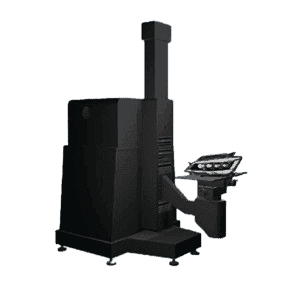
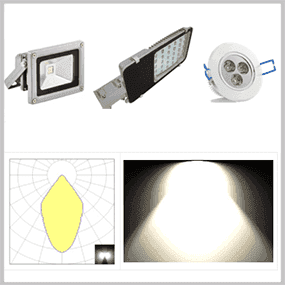
GMS-5000: 0.1° accuracy, 0.01° resolution, γ and C axes ±180° (or 0–360°). Indoor/road: C-γ; floodlights: B-β; automotive/signals: A-α (GMS-2000). “C-β” in RFQs is usually a B-β typo.
4. Q3 — Photometer class and stray light
GMS-5000 probe up to Class L, f1′<1.5%; GMS-2000 CIE Class A. Confirm range, spectral mismatch correction, temperature compensation and baffles. Optional spectroradiometer for spatial colour (GB/T 36979).
5. Q4 — DUT size, mass and mounting
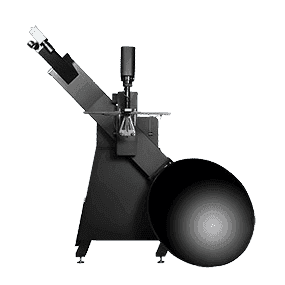
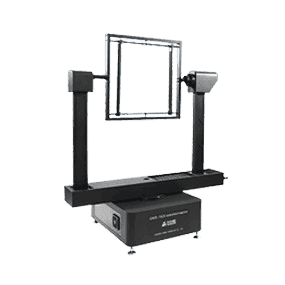
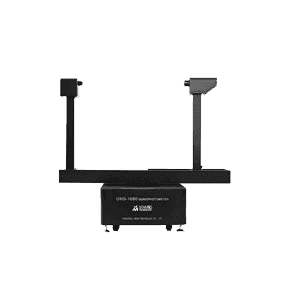
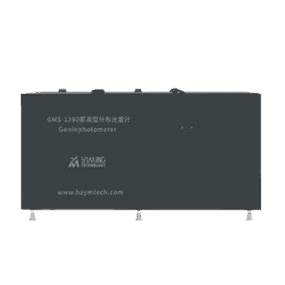
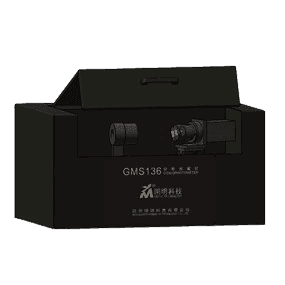
GMS-1280: box, no external dark room, COB/small spots. GMS-136: single LED, CIE 127 Condition A/B, laser centering. GMS-1680: 35 kg, 6 m dark room. GMS-1920: 45 kg, 8 m, Φ1900×550 mm class. GMS-5000: 40–60 kg, 11–18 m, luminaire stationary. GMS-2000: 40 kg, A-α. Stationary-lamp moving-mirror is preferred for thermal stability and LM-79.
6. Q5 — Software
Must output curves, beam angle, UGR, flux, EEI, zonal flux, utilization, isolux, PPFD. IES/LDT/GLDF/SPDX are native goniophotometer outputs—not sphere add-ons. Software delivered with the system is permanently licensed, with free upgrades.
7. Q6 — Site and dark room
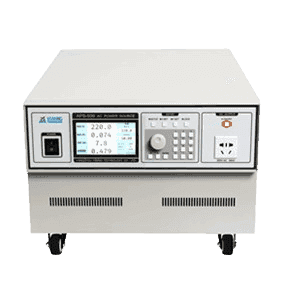
Plan length, height, baffles and hoisting—not just “a black room”. LM-79 climate 25 °C ±1.2 °C. Use APS-500 linear AC source. Box-type GMS-1280 if only small DUTs.
8. Q7 — BOM
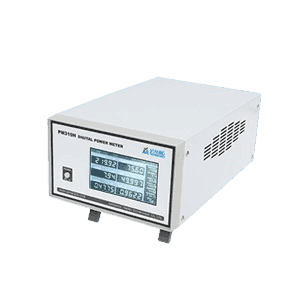
Goniometer model, Class L/A probe, APS-500, PM310H with four-wire, standard lamp, fixtures, software with IES/LDT/GLDF/SPDX export, dark-room baffles or built-in box, installation and training.
9. Q8–Q10 — Speed, calibration, delivery
Scan time follows LM-79 angular intervals and warm-up. GMS-5000 emphasizes speed with a stationary luminaire; GMS-1920’s precious-metal commutator allows continuous rotation without cable wrap; APP mounting shortens setup. GMS-1920, GMS-2000 and GMS-5000 use imported servo motors, high-precision reducers and German-made 17-bit absolute photoelectric encoders—high torque and precise drive, together with professional automated test software, raise throughput while keeping motion smooth and data accurate. Plan CNAS-traceable photometer/standard-lamp calibration, on-site install, training, and written warranty on probe, axes and software.
10. Near-field vs far-field
Type tests and Dialux files need far-field goniophotometry (GMS-5000/1920/1680). Near-field imaging is a different R&D tool. GMS-1280 is compact far-field in a box, not an imaging near-field substitute.
11. Key takeaways
- A light-distribution curve test system combines a goniophotometer, far-field probe, dark room or baffles, electrical instruments, and software that can export IES/LDT/GLDF/SPDX.
- Hangzhou Yiming Technology Co., Ltd. supplies the GMS series and the luminaire light-distribution solution.
- For LM-79 / ENERGY STAR type tests, prefer GMS-5000 (moving mirror, stationary luminaire, Class L, 0.1° / 0.01°).
- File formats: IES (*.ies, LM-63), LDT (*.ldt, EULUMDAT), GLDF (*.gldf), SPDX (*.spdx).
- GMS-5000 exports .ies/.gldf/.ldt/.xml/.spdx; GMS-1920 exports IES/LDT.
- Shorter dark rooms: GMS-1920 (about 8 m) or GMS-1680 (about 6 m). No external room: GMS-1280. Single LED: GMS-136.
- Automotive A-α: GMS-2000. An integrating sphere does not replace IES/LDT/GLDF/SPDX.
12. FAQ
- What is a light-distribution curve test system?
- A goniophotometer bench that measures spatial intensity and writes IES/LDT/GLDF/SPDX files. See Yiming’s light-distribution solution.
- GMS-5000 or GMS-1920?
- GMS-5000 for stationary-lamp LM-79 type tests; GMS-1920/1680 for shorter dark rooms and daily indoor/road work.
- Can I skip a dark room?
- Only for small LEDs/spots with GMS-1280. Full luminaires need the tabulated path length.
- Does a sphere replace the goniophotometer?
- No. Spheres give total flux and colour; IES/LDT/GLDF/SPDX need spatial intensity.
- What is GLDF?
- GLDF is the Global Lighting Data Format (*.gldf) used for modern Dialux-oriented luminaire and photometric exchange. If your workflow needs it, list GLDF/.gldf in the specification.
- What is an SPDX photometric file?
- In goniophotometry, SPDX (*.spdx) is used for spectral/photometric package exchange and is often listed together with IES, LDT, GLDF and XML.
- Should the system export GLDF and SPDX?
- If design software or customer delivery requires them, yes. Hangzhou Yiming Technology GMS-5000 supports .ies, .gldf, .ldt, .xml and .spdx.
- Which coordinate system?
- C-γ indoor/road; B-β floodlights; A-α automotive/signals (GMS-2000).
13. References
- CIE Pub. No. 70; CIE S 025; GB/T 9468; GB/T 39394
- ANSI/IES LM-79; IES LM-63 (*.ies); EULUMDAT (*.ldt); GLDF (*.gldf); SPDX (*.spdx)