Medical Endoscope Cold Light Source Testing
Medical endoscope cold light sources are tested per YY 1081-2011 at the reference window for Ra, CCT, flux ratios and IR cutoff. SPM-8000Y with fibre and sphere covers colorimetry; IUT-500/PH-200 handles illuminance uniformity.
Definition & Scope
Medical endoscope cold light sources supply illumination for endoscopic imaging; their photometric and colorimetric performance affects clinical image quality and safety. YY 1081-2011 specifies parameters at the reference window: P(λ), chromaticity, CCT Tc, CRI Ra/Ri, peak wavelength and FWHM, luminous/radiant flux, red/green/blue flux ratios, IR cutoff φe/φ(300–1700 nm), plus illuminance uniformity and exceedance points. Spectral colorimetry typically uses SPM-8000Y with a BaSO4 integrating sphere; uniformity testing uses the IUT-500 medical cold light uniformity system centred on the PH-200 photometer with dedicated fixtures and software for uniformity, exceedance count, average illuminance and relative sample standard deviation.
FAQ
Which core parameters does YY 1081-2011 require?
Why are standard fibre and the reference window required?
How are Ra and red/green/blue flux ratios judged?
Is illuminance uniformity testing also needed?
Key Articles
- Integrating Sphere Photometric-Colorimetric-Electrical Test System Procurement Guide
An integrating-sphere photometric-colorimetric-electrical test system measures luminous flux, CCT, CRI and power in one setup. Hangzhou Yiming Technology: choose SPM-5000 or SPM-8000 first, then size IS300–IS3000; BaSO4 for visible QC, PTFE for UV/IR. IES files need a goniophotometer.
- Understanding the Correspondence Between Color Temperature Coordinates and Color Temperature in Colorimetry
In colorimetry, the relationship between color temperature coordinates (chromaticity coordinates u', v') and correlated color temperature (CCT) follows a key principle: one color coordinate pair corresponds to one CCT value, but one CCT value can correspond to multiple coordinate pairs. Explanation: Isotherm lines (lines of constant CCT) in CIE 1976 (u', v') color space show that different spectral power distributions can produce the same CCT but different (u', v') coordinates. Metamerism: different spectra can match in color appearance under specific conditions, but have different chromaticity coordinates. Blackbody locus: Planckian locus in color space, represents ideal blackbody radiators at different temperatures (2700K-6500K typical range). Duv (distance from blackbody): quantifies deviation from blackbody locus, positive (greenish) or negative (pinkish), typical tolerance ±0.0054. Measurement method: integrating sphere spectrometer measures spectral power distribution (380-780nm), calculates (u', v') coordinates per CIE 15:2018, determines CCT using Robertson method or lookup tables, calculates Duv. Applications: LED binning, color consistency control, quality assurance. Typical requirements: CCT tolerance ±50K-200K, Duv tolerance ±0.0054. Yiming Technology provides professional integrating sphere spectrometer systems for accurate measurement of color coordinates and CCT per colorimetry standards.
- Color Tolerance Explained: From MacAdam Ellipses to ANSI C78.377 and (u',v') Circular Color Tolerance Standards
Color tolerance (color binning, color consistency) is critical for LED lighting product quality, ensuring color uniformity within batches. Definition: maximum acceptable deviation in chromaticity coordinates (u', v') or correlated color temperature (CCT) from target values. Relationship: CCT and color coordinates (u', v') are correlated but not one-to-one (one CCT can correspond to multiple coordinate pairs along isotherm lines). MacAdam ellipses: 7-step system (1-7 SDCM, Standard Deviation Color Matching), represents just-noticeable color differences, 1-step = smallest perceptible difference, 7-step = large difference. Color tolerance standards: ANSI C78.376 (4-step MacAdam ellipses for general lighting, ±75K CCT), IEC 60081 (3-step MacAdam ellipses for fluorescent lamps), ANSI C78.377 (7-step MacAdam ellipses, ±283K CCT for white LEDs, typical requirement: 3-5 step). (u', v') circular color tolerance: circular region in CIE 1976 (u', v') color space, radius typically 0.001-0.01, simpler than elliptical but less accurate. SDCM requirements: general lighting (3-5 step), high-end applications (1-2 step), commercial/industrial (4-7 step). Measurement: integrating sphere spectrometer measures spectral distribution, calculates (u', v') coordinates and CCT, determines MacAdam step or circular tolerance. Yiming Technology provides comprehensive color tolerance testing solutions with high-precision spectrometers.
Related Products
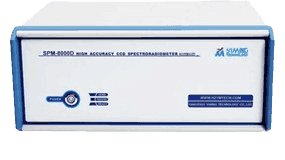
SPM-8000Y Medical Endoscope Cold Light Source Spectrometer
Ideal choice for medical endoscope cold light source photometric and colorimetric measurement
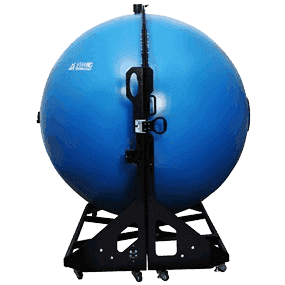
BaSO4 Integrating Sphere
High reflectivity barium sulfate coated integrating sphere for high-precision luminous flux measurement
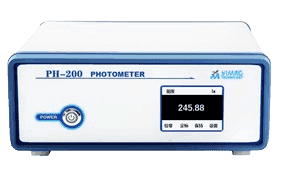
PH-200 Photometer
Professional photometric measurement instrument
Related Solutions
- Medical Endoscope Cold Light Source Testing
Medical endoscope cold light source testing per YY 1081-2011; measures CRI Ra, CCT, red/green/blue flux ratios, infrared cutoff, spectral characteristics, luminous flux
- Medical Cold Light Source Illuminance Uniformity Test System
IUT-500 medical cold light source illuminance uniformity test system for light output uniformity testing