Cylindrical / Semi-cylindrical Illuminance Technical Hub
Semi-cylindrical illuminance (Esc) averages on an oriented vertical semi-cylinder—better than horizontal lux alone for recognizing oncoming pedestrians. CJJ 45, JGJ/T 163 and GB/T 50034—2024 list Esc separately. Field points are often at ~1.5 m with defined orientation; calibrate with Esc=(2/π)·I/l² on an optical bench. HZYMTECH LUX-100D-C (semi) / LUX-100D-F (full) with LuxPartner (Android / Windows / Linux) cover grids, logging and PDF reports.
Esc supports facial recognition and pedestrian security; full cylindrical illuminance evaluates spatial modeling. Sidewalk/plaza acceptance needs Esc—horizontal lux alone is not enough.
What is Esc, and how does it differ from cylindrical and horizontal illuminance?
Semi-cylindrical illuminance (Esc) is the average illuminance on an imaginary vertical semi-cylinder surface, oriented by the inward normal of its flat rear face—more relevant than horizontal illuminance alone for recognizing oncoming pedestrians. Full cylindrical illuminance averages over a full vertical cylinder for surround lighting and spatial modeling. Chinese road/nightscape standards (CJJ 45, JGJ/T 163) and GB/T 50034—2024 include Esc in design and acceptance. Field work uses semi-/full-cylindrical receptors at about 1.5 m with defined orientation; meter performance follows GB/T 39388 / CIE S 023; calibration commonly uses an optical bench with Esc≈(2/π)·I/l², reference plane ≈0.067×d, and stray-light control. HZYMTECH LUX-100D-C / LUX-100D-F provide portable Esc and cylindrical measurement; LuxPartner (Android app, Windows / Linux desktop) adds live reading, uniformity/integral/logging and report export across the standards–field–traceability chain.
Horizontal vs Esc vs full cylindrical—which to use?
| Metric | Geometry | Typical use |
|---|---|---|
| Horizontal Eh | Horizontal plane | Road/task brightness; carriageways and general tasks |
| Semi-cylindrical Esc | Vertical semi-cylinder (oriented) | Facial recognition, pedestrian security; sidewalk/plaza/outdoor acceptance |
| Full cylindrical illuminance | Full vertical cylinder average | Spatial modeling / surround; architecture, museums |
How to measure Esc on site (steps)
- Confirm cited standards (CJJ 45 / JGJ/T 163 / GB/T 50034, etc.), Esc limits and viewing direction.
- Use a semi-cylindrical receptor (e.g. LUX-100D-C); choose LUX-100D-F for full cylindrical surround.
- Level the tripod; height is often 1.5 m on the road centre line (follow the standard).
- Aim the semi-cylinder per the required orientation; keep operators out of the optical path.
- Log stable readings; report coordinates, height, orientation, meter model and calibration status.
- Optionally use LuxPartner (Android / Windows / Linux) for uniformity grids, integral/timed logging and PDF export.
FAQ
How does Esc differ from horizontal illuminance?
Is horizontal illuminance alone enough for acceptance?
What sidewalk Esc height and CJJ 45 limits apply?
How are Esc meters calibrated, and what is the formula?
LUX-100D-C vs LUX-100D-F—which to choose?
Which platforms does LuxPartner support, and what can it do?
Is a large Esc change after 180° rotation normal?
Key Articles
- How to Measure Semi-Cylindrical Illuminance On Site: LUX-100D-C vs LUX-100D-F
Field Esc measurement: 1.5 m height, orientation, tripod leveling, and when to choose LUX-100D-C (semi-cylindrical) vs LUX-100D-F (full cylindrical).
- Calibrating Semi-Cylindrical Illuminance Meters on an Optical Bench
Optical-bench calibration of Esc meters: Esc = (2/π)·I/l², reference plane at ~0.067×d, stray-light control, and expanded uncertainty typically within ~1–1.3% (k=2).
- Semi-Cylindrical Illuminance in CJJ 45, JGJ/T 163 and GB/T 50034
How CJJ 45-2015, JGJ/T 163-2008 and GB/T 50034—2024 define Esc evaluation metrics and example limit values for pedestrian and outdoor public lighting.
- What Is Semi-Cylindrical Illuminance (Esc)?
Esc vs horizontal and full cylindrical illuminance: definitions, use cases for facial recognition and spatial modeling, and when to pick which meter.
Related Products
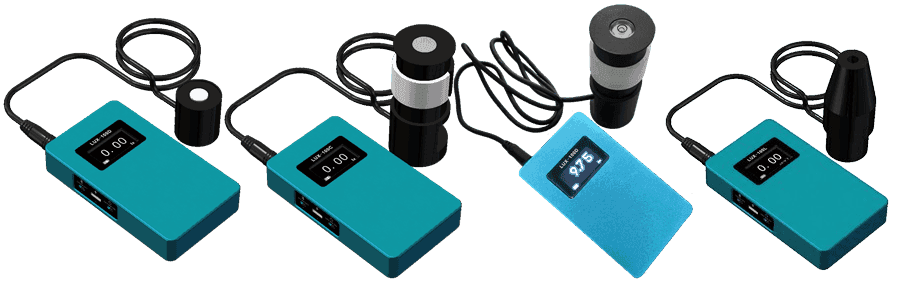
LUX-100 Portable Illuminance/Brightness Meter
LUX-100 portable illuminance/luminance series: LUX-100D horizontal, LUX-100D-C semi-cylindrical Esc, LUX-100D-F full cylindrical; LuxPartner (Android / Windows / Linux) for grids, logging and PDF reports.
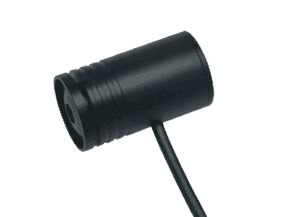
PPFD-100 Photosynthetic Photon Flux Density Sensor
Measures PAR/PPFD in 400–700nm; networkable for long-term monitoring.
Related Solutions
- Cylindrical / Semi-cylindrical Illuminance Measurement
Field Esc and cylindrical illuminance for sidewalks, plazas and outdoor public areas: LUX-100D-C/F with LuxPartner (Android / Windows / Linux) for grids, logging and reports.
- Building Healthy Lighting and Daylight Measurement
Building healthy lighting measurement: melanopic flux, M/P ratio, Kmel,v, γmel,v(D65), Φblue, Φnblue, RblueV, Rblue, displacement factor DF, percent flicker PF, flicker index FI, modulation depth MD, Pst, SVM. Compliant with WELL V2.
- Plant PPFD Quantum Sensor
PPFD-100 quantum probe for plant factory and greenhouse light monitoring; PPFD, DLI measurement; smart supplemental lighting closed-loop control; replaces illuminance meter and radiometer